Give an incident a trustworthy record.
Overseer brings inventory, probes, incidents, and investigation into one operations console. I built it around a problem I recognise from incident command: responders need to know which observations they can trust before deciding what to change.
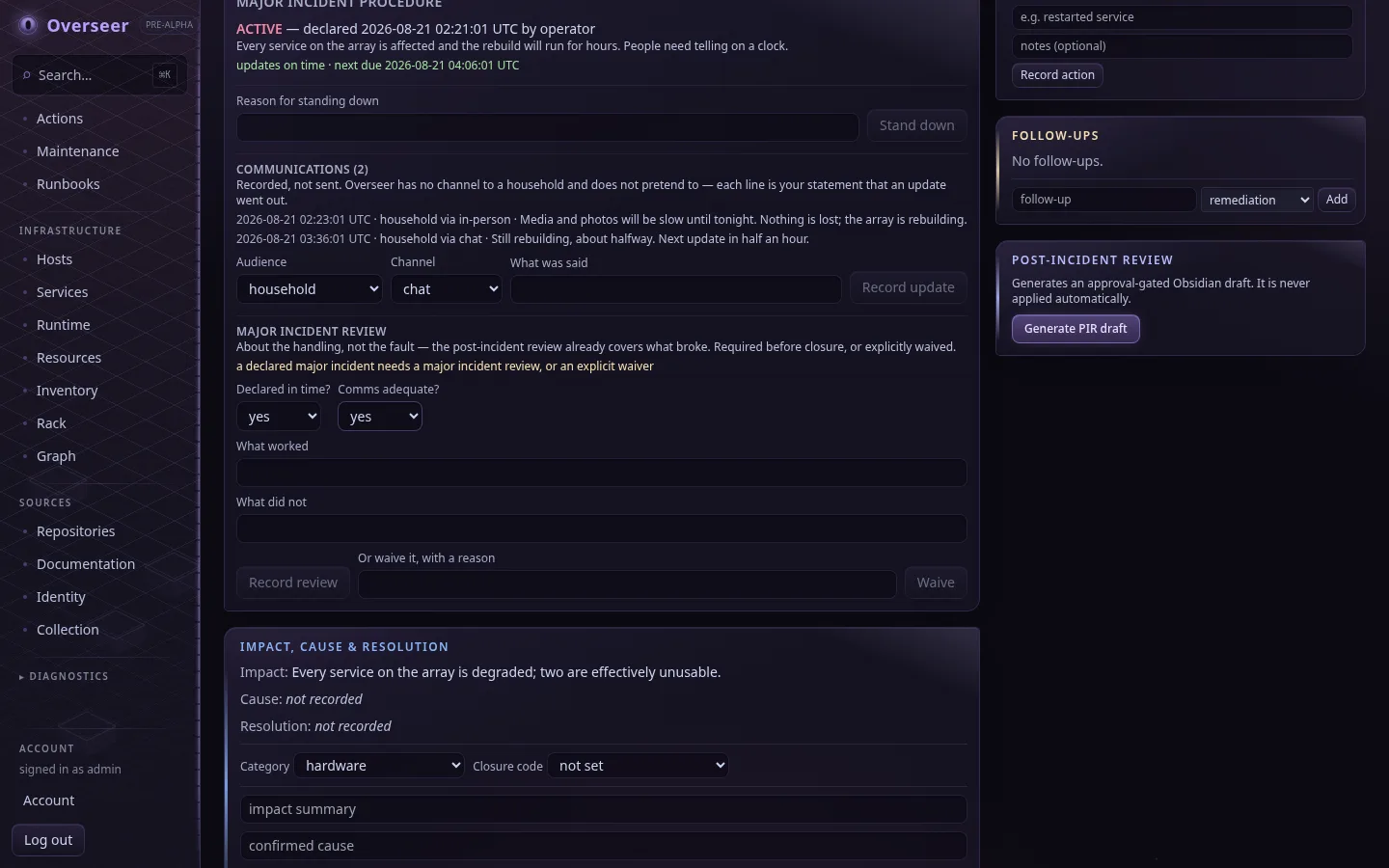
The problem
A service can answer inside a host while every public check fails. Treating those observations as one green-or-red signal loses the distinction between an application failure and a failure in the access path. Missing observations add a second risk: a monitor can look reassuring after it stops reporting.
My responsibility
I designed, built, and operate the console, probe integration, incident workflow, and bounded agent investigation. My professional incident-management experience informs the separation between observation, attribution, proposed action, and verified recovery.
How the system fits together
- CollectProbes and read-only connectors report observations.
- CorrelateEvidence feeds incident attribution and timelines.
- InvestigateA bounded agent reports findings for review.
- VerifyMonitors establish whether recovery occurred.
The Node application and SQLite store preserve incident state and collected evidence. React presents the workspace; Discord carries acknowledgement and review decisions. The public product site is deployed separately as static files.
Decisions and tradeoffs
| Decision | Why | Cost or boundary |
|---|---|---|
| Keep source, collection time, and freshness | A fact must remain traceable to an observation. | Unknown and stale states require explicit handling throughout the UI. |
| Preserve contradictory internal/external checks | Healthy internally and unreachable externally is useful evidence of a path fault. | Attribution is evidence-based classification, not proof of root cause. |
| Wait for a sustained condition and group related failures | One estate-wide failure should have a coherent incident record. | The persistence threshold trades immediate filing for less noise. |
| Bound investigations and review proposed actions | Investigation should collect evidence without silently changing the estate. | A human decision remains part of the operational workflow. |
Validation and current outcome
The repository includes Playwright end-to-end tests against a seeded fixture estate. The public walkthrough separately tests acceptance, rejection, recovery, reset, mobile overflow, and absence of API requests. The console is used in my own infrastructure; the published material does not establish a measured reduction in resolution time.
Overseer is under active development. The product walkthrough demonstrates evidence and review; accepting a finding in it does not execute remediation.
What this demonstrates
Turning operational experience into an explicit state model, preserving uncertainty, designing review boundaries, and testing incident behavior with reproducible fixtures.
Implementation basis: the owning repository’s README, product-site documentation, and public fixture screenshots. Explore the public product documentation.